Category: Uncategorized

The Missing Economy: Small Business, Ownership, and Uneven Growth in Central New York

Contributing Authors: Jared Shepard, Director of Planning and Research at CenterState CEO & Skylar Richardson, Impact & Evaluation Coordinator, CenterState CEO

Central New York’s economy is growing. After more than a decade of federal and state investment in industrial policy, employment growth in 2025 reached its highest level since the late 1990s, signaling the start of a new era of economic opportunity for the region. However, in line with national trends, recent job gains have been concentrated among large firms. Although total employment increased, most net new jobs were created by major employers, while many small and mid-sized businesses saw their workforce shrink.

This divergence matters. Small and mid-sized businesses account for more than half of regional employment and serve as the principal vehicles for local ownership, neighborhood stability, and wealth creation. They are the institutions through which macroeconomic growth becomes embedded in communities. When employment growth bypasses these firms, the region’s expansion becomes narrower, less locally rooted, and less likely to translate into broadly shared prosperity.

Reversing the decline in small business employment will require more than continued aggregate growth. Structural barriers, shaped in large part by decades of racially discriminatory policies, along with other forms of exclusion, continue to constrain who can start, scale, and sustain businesses in the region. Practices that still exist today, such as predatory and discriminatory lending, suppress entrepreneurial participation, limit access to capital and contracts, and reduce labor market mobility. The cumulative effect is substantial: across Buffalo, Rochester, and Syracuse, an estimated $17 billion in annual economic activity remains unrealized.

Strengthening small- and mid-sized businesses, therefore, is not only a matter of equity but of economic performance. Targeted investment in historically and currently excluded entrepreneurs and workers would expand business formation, stabilize employment, and enable the region to more fully capture the gains associated with large-scale industrial investment. In this context, inclusive growth is not a secondary objective, it is central to the region’s long-term competitiveness. 

Regional Employment Trends

Based on data from the Quarterly Workforce Indicators (QWI) ,a comprehensive database from the U.S. Census Bureau that tracks local employment movements—the Syracuse Metropolitan Statistical Area (MSA) is experiencing a historic shift in its employment landscape. While the region reached record-high total employment levels in 2024, the growth is increasingly concentrated in large-scale enterprises, while smaller firms struggle to regain their pre-pandemic footing.

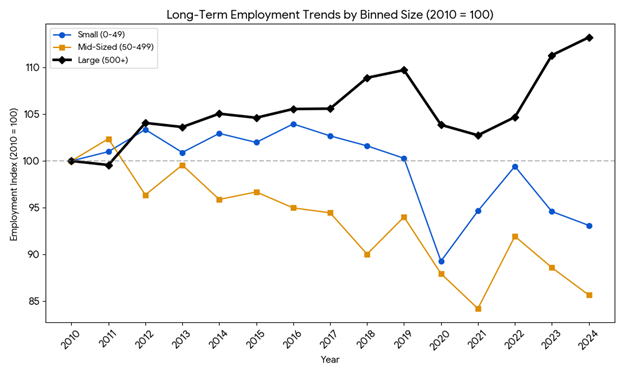
Indexing the data to 2010 provides a longer-term perspective on this shift within the Syracuse economy, revealing that the current “K-shape” is not just a post-pandemic phenomenon but a continuation of a decade-long trend, with strong acceleration starting in 2022.

Key Trends Since 2010:

  • Large Business Dominance: Large firms (500+ employees) have shown the most consistent and resilient growth. As of 2024, employment in large businesses increased by more than 13% relative to its 2010 level.
  • Small Businesses (0–49): While they saw a temporary boost around 2022, they ended 2024 at approximately 93% of their 2010 workforce levels.
    • Mid-Sized Firms (50–499): This segment has faced the steepest long-term decline, now operating at just 85.6% of its 2010 employment levels.
While record-high employment in large-scale enterprises provides a strong foundation for Central New York, the long-term health of our communities depends on a thriving small business sector to serve as a stabilizer. Transforming our regional corridor requires removing barriers that limit full participation in ownership and revenue growth, particularly for entrepreneurs from historically under-resourced backgrounds.

Racial Disparities in Business Formation and Revenue

While major regional drivers like Micron indicate a new era of growth, the small business scene in the Syracuse, Buffalo, and Rochester corridor remains significantly underdeveloped for entrepreneurs of color. Current data shows a stark racial gap in business density and revenue.

Across Syracuse, Rochester, and Buffalo, the gap in business formation remains large and consistent: White-owned businesses range from 16 to 18 per 1,000 residents, while Black-owned businesses range from 2.3 to 4.7 per 1,000 residents. These disparities are not the result of differences in talent or effort, but of unequal access to capital, networks, and opportunity compounded over time.

While the typical white-owned business in the area earns between $3 million and $3.6 million annually, Black-owned companies average between $846,000 and $1.1 million.[1] Bridging these gaps could serve as a major boost to the regional economy. Achieving ownership and revenue equality could generate more than $17.6 billion in new annual economic activity.

How we calculated the gap:

  • We start with a simple question: what would regional business revenue look like if Black residents had the same opportunities and participated in business ownership at the same rate and scale as White residents?
  • First, we use population data to estimate how many Black-owned businesses would exist if Black residents owned businesses at the same rate per 1,000 people as White residents in the same metro area.
  • Next, we estimate the revenue those businesses would generate by applying the average revenue of White-owned firms in that market. This provides a realistic, local benchmark.
  • We then compare that expected revenue to actual revenue generated by Black-owned businesses today.
  • The difference between the two reflects economic activity that is hindered by ongoing barriers to entry, growth, and scale in the local economy, stemming from generational ownership barriers.
  • Using this population-parity approach, we estimate that Buffalo, Rochester, and Syracuse together are missing approximately $17.6 billion in business revenue each year.
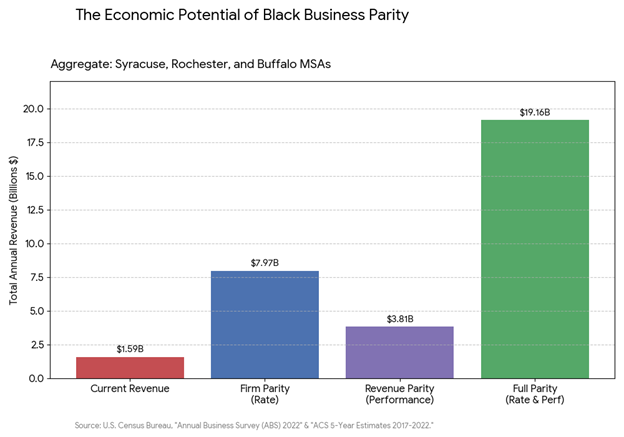
The “Missing Economy” breakdown:

  • Current Revenue ($1.59B): The current combined annual revenue of Black-owned employer firms in the Syracuse-Buffalo-Rochester region.
  • Firm Parity ($7.97B): Projected revenue if Black residents owned businesses at the same rate as white residents (approx. 18 firms per 1,000 people).
  • Revenue Parity ($3.81B): Projected revenue if the current number of Black-owned firms achieved the same average annual sales as white-owned firms ($3M–$3.6M).
  • Full Parity ($19.16B): The total output if Black-owned businesses matched white firms in both rate and revenue performance.

The data make clear that the region’s “Missing Economy” is not a single-issue challenge, nor one that can be addressed through generalized growth alone. Closing this gap will require reducing barriers to business formation, expanding access to capital and technical assistance, and strengthening pathways for small firms to scale into mid-sized and larger enterprises. These interventions are not peripheral, they are central to ensuring that recent industrial investment translates into durable regional capacity.

Record-high employment among large employers provides an important foundation for Central New York’s economy. But long-term regional stability depends on a robust small-business sector that anchors neighborhoods, broadens ownership, and drives local growth. Persistent ownership and revenue gaps, particularly among entrepreneurs who have historically been excluded, constrain our economy and opportunities for shared prosperity. Narrow participation in the ownership economy limits firm formation, slows scaling, and weakens the region’s overall competitive position.

These disparities are not accidental. Policies and practices that restrict access to property ownership, credit, and fair compensation through mechanisms such as redlining, exclusionary zoning, and discriminatory lending continue to have economic effects. In Syracuse and other cities across the region, these patterns shaped who could accumulate assets and who could not. Because returns to capital compound over time, the effects of exclusion compound as well, producing intergenerational differences in wealth, business ownership, and market participation.

Addressing these structural constraints is therefore both an equity imperative and an economic strategy. Markets function most effectively when access to ownership, capital, and opportunity is broad. Expanding participation in the small business economy would increase firm formation, strengthen local supply chains, and unlock unrealized productive capacity, as reflected in the estimated $17 billion in annual economic activity across Buffalo, Rochester, and Syracuse. In this context, inclusive growth is not ancillary to competitiveness; it is foundational to the region’s long-term economic performance. If we value capitalism for its ideals of creating opportunity, rewarding merit, and driving innovation and human flourishing, then strengthening those ideals requires expanding access to ownership, capital, and growth so more people can fully participate. Doing so is both a moral imperative and a practical strategy for building a stronger, more resilient regional economy.


ABOUT THE AUTHORS
Jared Shepard is Director of Planning and Research at CenterState CEO. His work includes economic and industrial policy analysis, attainable housing development, and inclusive ownership—examining how capital access, policy design, and market structure shape long-term wealth creation in communities.
Skylar Richardson received her undergraduate degree in Psychology from SUNY Oswego in 2025 and has worked at CenterState CEO since then. In her role as Impact & Evaluation Coordinator, she leads data management and analysis efforts, supporting program evaluation and GIS-based insights to inform organizational strategy and reporting.

Share

Meeting People Where They Are: Inside Cortland’s Trauma-Informed Grace Space

Written By: Aster Parrott, Director of Public Health Infrastructure at the Rural Health Institute of New York and Ashley Lewis, Epidemiologist at the Rural Health Institute of New York

From November 2024 to April 2025, the Rural Health Institute of New York (RHI) and other Cortland County community partners successfully piloted a low-threshold, data-driven daytime resource hub for people experiencing housing insecurity and homelessness. This center–the Grace Space–was housed at Grace and Holy Spirit Church in downtown Cortland.

RHI’s home county of Cortland has no shelter and only limited practical availability of daytime warming centers in winter. As in many other communities, many Cortland residents do not have a safe, dedicated place to live, and many who do experience housing insecurity due to high housing costs. Our landscape analysis and interviews with unhoused residents revealed daily displacement, limited access to services, and a need for a safe, stigma-free space, along with gaps in cross-agency coordination and representation in local data systems. 

We adopted two priorities: 1) pilot a low-threshold daytime space to help keep people warm and safe and 2) improve the local data collection and sharing infrastructure. We designed the Grace Space to address both of these goals. The same tools needed to manage daily operations were intentionally designed to capture and organize information for broader analysis and community planning. 

As a trauma-informed daytime center, it provided safety, reduced the risks of displacement, and connected guests to housing, healthcare, and social supports. It was a safe, warm space to be and use amenities such as laundry, showers, and phone charging. We coordinated with local non-profits to bring community resources together in one place, reducing barriers to access by literally meeting people where they are and helping them complete multiple steps at once. Our low-threshold model meant we never required guests to engage with any service providers in order to use the space.

We looked beyond public health, specifically trauma-informed design, to make it to feel safe, welcoming, and centered on their needs. Trauma-informed design centers the physical, psychological, and emotional safety of clients and service providers. It was crucial for us to do all that we could to make guests feel like they belonged in the Grace Space and that they had dignity, agency, privacy, and community there. We also looked to hospitality as a model, framing the people who came to the Grace Space as guests, not clients, to help emphasize this.

As an integrated data system, the Grace Space tracked needs in real time, coordinated referrals across agencies, and produced high quality local data, which is a particular need in rural communities. We built a system for tracking check-ins, guest profiles, services and referrals, and utilization of amenities like storage lockers, showers, and laundry. Using a no-code relational database system allowed us to easily connect different kinds of information to individual guest profiles automatically. We sought to build health equity into our systems by, for example, using more granular and person-centered demographic categories. We attempted to collect full data from all guests without violating their trust or comfort, allowing them to choose what information to share and telling them transparently about how we would use the data. We built a real-name database of individuals experiencing homelessness, allowing for coordinated case management and continuity of care.

Throughout the season, we adapted the system. Being able to tailor this system meant that staff actually used it for their own needs and for the data collection. Direct service staff talked directly with the database designer to explain what could be improved. We could then make changes in near real-time that went live everywhere at once, and avoided spending time transposing data from paper forms into a digital reporting system.

From February to April 2025, the Grace Space staff created 291 guest profiles, 253 of which contained complete data. Across 62 operating days, staff recorded 2,576 total check-ins, an average of 11 visits per guest, with some guests engaging as many as 65 times. The space facilitated 607 service referrals, including 110 from Grace Space staff and 497 from visiting partner agencies. To read more about how we made the Grace Space happen and what we learned, you can explore our full report here.

In November 2025, RHI purchased a building to reopen the Grace Space as a permanent, year-round resource hub. Still located in downtown Cortland, it is within walking distance of many relevant non-profits, the new County Mental Health Clinic, the nighttime warming center, and multiple bus stops. More usable interior space, means we can comfortably host more guests than during that first winter. Renovations are currently under way, with plans to open the new Grace Space by January, 2026.

Starting in October 2025, we partnered with Cortland County’s Department of Social Services (DSS) and the Salvation Army to pilot an expansion. The Salvation Army, funded by DSS to operate the Code Blue nighttime warming centers, has replaced their isolated, paper check-in process with a customized interface into our system. This collaboration will enable targeted outreach and improved referrals, as well as a more complete picture of homelessness in the County, marking the start of community-wide coordination of services for unhoused or insecurely housed people. We are already working to further integrate into the local social care landscape. Agencies that provide services for people who are unhoused or insecurely housed, such as CAPCO (which operates WIC, Head Start, home energy assistance, and family development programs) and Catholic Charities (which has an outreach and ongoing support program to get and keep people housed) have been close partners since the start of the pilot.

The Grace Space’s first winter was a successful and informative pilot program, but we still have much to learn, especially as we transition to become a permanent space and as we further integrate into the community’s social service landscape. We hope that we will be able to share what we have learned through direct partnerships, best practices, and policy recommendations so that other communities can support all their residents, as Cortland is working to do.

Share

NY Legislators Move to Lessen Long-Standing Nonprofit Contract Delays

Central Current recently published an article detailing New York State’s efforts to address a long-standing challenge for nonprofits: delayed payments on state contracts. Legislators have approved an overhaul that includes provisions such as 25 percent advance payments, interest on late reimbursements, and automatic contract renewals—steps designed to relieve the heavy financial strain nonprofits face when state funds are held up for months. While the bill still awaits the governor’s signature, its passage by lawmakers reflects growing recognition that these delays jeopardize essential services across the state.

For readers seeking a deeper look at how this issue has impacted our region, the Central New York Community Foundation’s issue paper, Payment Pending: CNY Nonprofit Funding Delays From the State Level, outlines the history and scale of the problem locally. Our analysis shows how chronic delays can force nonprofits to take out short-term loans, delay programming, or strain staff capacity. Together, these resources provide important context on a pressing challenge for the nonprofit sector and highlight why timely state funding is critical to sustaining community programs. View the Community Foundation’s impact investing page to learn about loans provided to local nonprofits experiencing delays.

Share

Paper Released: An Early Warning – Unpacking the Lead-Literacy Connection

Two and a half percent. That is the percentage of one-year-olds in Onondaga County who tested positive for lead poisoning in 2024. That is also the percentage of lead poisoning cases that could have been prevented with an early warning system designed to intervene when children are in the extremely vulnerable 0-12 month age range. Even more alarmingly, less than 20% of students in the Syracuse City School District (SCSD) have tested proficient in reading and writing by grade three in the past decade.

The Central New York Community Foundation’s latest issue paper examines the relationship between childhood lead exposure and third grade English Language Arts proficiency in Syracuse, NY. Their findings reveal a strong correlation between elevated blood lead levels in early childhood and low reading and writing scores later on. They present a new early warning system designed to identify and assist children in high-risk neighborhoods before exposure occurs, with the goal of improving long-term academic outcomes.

View Issue Paper

Share

Whole Family Summit Provides Action Steps To Improve Support For Low Income Families In Onondaga County

Guest Authors: Maribel Arce, Director of Grants and Planning, PEACE, Inc.

Todd Goehle, Vice President of Operations and Strategy, PEACE, Inc.

In November 2024, PEACE, Inc. and FOCUS Greater Syracuse, Inc. convened more than 80 community leaders, service providers, funders, and family members. Through the support of the Central New York Community Foundation, the Kresge Foundation, and the National Community Action Partnership, the event explored how to meet the basic needs of Onondaga County families living in poverty through a Whole Family approach, also known as 2Gen or 2 Generation. Inspired by the Aspen Institute’s Ascend 2Gen Framework, this approach integrates support across generations—addressing education, employment, financial stability, health, social capital, and housing.

Real Stories, Real Lessons

The goal of the “Whole Family Summit to Meet the Basic Needs of our Community“ was to learn about and enhance the community’s capacity to develop collaborative, family-centric solutions for overcoming basic needs barriers. The event offered insights from national and local experts who apply whole family approaches in their respective work. Incorporating these lessons learned, attendees participated in a human-centered design process and engaged with research-based, family case studies to develop solutions for barriers commonly faced by families.

Key Recommendations from the Summit

Participants offered several clear, actionable strategies and steps to serve families better:

1. Design with Families, Not for Them

Families are experts of their own lives. Their situations can be both complex and challenging. A crisis that happens to a family member can reverberate through an entire household. This can be especially true for families living in poverty where financial constraints might force painful decisions and limit their ability to respond to crises.

During the case studies, participants emphasized the importance of truly understanding families and the context in which they are trying to achieve their goals. Participants noted that many support services for families are overwhelmed by the magnitude of need in the community (e.g. housing, food pantries, and mental health support). As one participant noted, “There are so many waiting lists right now that by the time they get help, something traumatic has happened.”  To effectively assist families in navigating this complex landscape, a whole family approach helps service providers understand each family’s strengths, fears, anxieties, and barriers. As a result, participants recommended solutions grounded in a whole family approach that expand the capacity and resilience of overburdened families and service providers by:

  • Simplifying application processes.
  • Creating a centralized application system.
  • Using clear, accessible language (avoid acronyms).
  • Offering flexible access points (online, in-person, phone) and delivering services outside of traditional 8:00 AM to 5:00 PM hours.
  • Providing a clear timeline, step-by-step guidance, and regular check-ins with reminders.
  • Including grace periods and recovery pathways for managing unforeseen setbacks.
  • Providing childcare, transportation, and translation services to reduce barriers.
  • Locating services in high-need neighborhoods through mobile units or satellite offices.

2. Strengthen Resilience-Building Networks

A whole family approach requires us to strengthen both formal systems and informal networks so families aren’t left to navigate challenges alone. A novel factor to the whole family approach is that it builds on the strength and resilience of families by emphasizing social capital. For the participants, true resilience emerges from relationships and collaborations across issues, providers, and generations. Specifically, participants proposed:

  • Building social capital networks of service workers
  • Investing in peer support groups and creating intergenerational community bonds
  • Supporting advocacy groups and develop local facilitation skills
  • Ensuring intergenerational voices are part of every conversation

3. Shift from Compliance to Thriving

While the Summit’s goal was to develop solutions for meeting basic needs, after applying the whole family approach, participants emphasized that meeting basic needs is essential but insufficient. To truly help families thrive, not just survive, we must move beyond systems that emphasize compliance to ones that foster resilience and success. Programs should offer client-driven rather than pre-determined solutions and reduce silos created by focusing only on targeted issues or client segments (i.e. participants noted that “Lead is affecting children’s lives, but we keep testing children instead of fixing the houses that are poisoning them.”) Action steps offered by attendees included:

  • Providing Income and wealth-building programs like the Earned Income Tax Credit (EITC), Child Tax Credit, and Family Self-Sufficiency (FSS).
  • Creating benefit slides—not cliffs—that support gradual progress out of services such as Onondaga County’s 2Gen Program.
  • Educating families on poverty prevention and wealth creation such as estate planning, financial literacy, basic legal forms, life insurance, retirement savings, etc.
  • Providing transportation solutions that impact access to everything from employment to healthcare to education

A Call to Serve, Not Just Strategize

The Whole Family Summit concluded with a powerful call to action from a community participant:

“Don’t pat yourself on the back for the goals you’ve met. Let the people tell you when you’ve actually helped them. Stop wasting time in meetings that make you feel good—get out and serve the people you say you’re serving.”

Sharing the report is part of FOCUS Greater Syracuse and PEACE, Inc.’s commitment to continuing this work alongside families and partners. Agencies can use this report to improve their programs and services. Together, we can build a Central New York where every family has the opportunity to thrive.

About PEACE, Inc.
People’s Equal Action and Community Effort, Inc. (PEACE, Inc.) has served as the federally designated Community Action Agency for Onondaga County since 1968. The agency pursues a mission to “help people in the community realize their potential for becoming self-sufficient” through nine antipoverty programs that serve 10,000 clients.

About FOCUS Greater Syracuse
FOCUS Greater Syracuse, Inc. is a citizen-driven organization that taps citizen creativity to bring about change in Central New York by enabling citizens, organizations and government to work together to enhance the quality of our lives and our economic future.

Share

Why Investment in the Arts is Critical to the Economic Revitalization of Downtown Syracuse

The arts are a significant economic driver for Central New York, and the arts landscape developing on South Salina Street is a vital part of the financial growth of Downtown Syracuse. In June Redhouse Arts Center will unveil a new LED marquee, joining the historic Landmark Theatre marquee to provide Syracuse with two beacons of light demonstrating the broad impact performing arts and arts education have on our local economy and why the arts are a vital, vibrant, and viable area for economic investment.

The Landmark Theatre is a living connection to almost a century of Syracuse history, listed on the National Register of Historic Places, and an architectural jewel in Central New York. As a destination for national touring concerts, comedy, family shows, and Broadway productions, the Landmark brings world class entertainment into the heart of downtown Syracuse and is an anchor of the South Salina Street Downtown Historic District.

In 2024, the Landmark welcomed over 163,000 ticketed guests, with another 20,000 attendees at free and private events and tours. Over half of these guests traveled here from outside Onondaga County, and 37% traveled from outside Central New York. These guests generated over $5 million in spending outside the theatre, filling up our neighboring restaurants, bars, stores, and more.

The Landmark also contributed directly to the economy, with $3.9 million in direct expenditures, including $2 million in payroll, contractors, and local professional services. This includes over $220,000 for security, over $250,000 for concessions, housekeeping, and box office staff, and $900,000 for stagehands. This payroll overwhelmingly stays local and circulates in our economy.

Lastly, presenting partners invest millions every year on local advertising, catering, per diems, and hotels. In total, over $11 million in local economic activity was generated in 2024 by the Landmark Theatre, its partners, and its guests.

And the Landmark does all of this while collaborating with local presenters and producers. In recent years, the Landmark Sponsored Events program has facilitated programming from the Syracuse Orchestra, the Community Folk Art Center, the CNY Jazz Arts Foundation, Make a Wish Central New York, and more. By making the Landmark more affordable and accessible for area nonprofits, Landmark diversifies its programming, attracts new audiences, and continues the tradition of local use at our community’s theatre.

Just next door to the Landmark is Redhouse Arts Center. Having celebrated its 20th anniversary in 2024, Redhouse does more than bring attendees to year-round theatrical productions. Annually more than 50,000 come through its doors for mainstage productions, performing arts programming, and rental events – all driving economic impact.

For its mainstage productions, more than 80% of those hired to work on Redhouse productions are area residents, who are then joined by out-of-town professionals. It is through the development and career pathing of this local workforce that Redhouse intentionally connects its theatrical work to its robust educational programs. In addition to in-house programs, Redhouse provides arts education in SCSD schools and will be a leading participant with its STEAM High School. By providing training for those aged 6 to 18, the goal is to empower local students with opportunities to develop careers in the arts as designers, directors, technical crew, and performers. The development of these local professionals creates long-term economic impact, enhancing a professional local employment sector to support the increasing entertainment needs of CNY.

The Redhouse’s 43,000 square foot venue, opened in 2018, provides Syracuse with a state-of-the-art facility comprised of multiple theatres, rehearsal studios, scenic and costume shops, and a sound-recording studio, all of which are fully accessible for those with mobility challenges. The venue regularly hosts daytime corporate web-based presentations and evening and weekend community events. As a site designated for NYS Film tax incentives, Redhouse has become a destination for film and television production.

Nationally, Redhouse has gained attention as a welcoming venue for theatrical tours which utilize the facility to prepare productions which then travel the nation, many of which end up with production runs at the Landmark next door.

It is this remarkable combination of artistic productions, performing arts education, and space for corporate and community events, all in a fully accessible venue, that creates broad economic impact. And, once the marquee is formally lit, the combination of two illuminated marquees on S. Salina Street will provide a visible and exciting welcome to all visiting downtown Syracuse.

The leadership at the Landmark and Redhouse understand the synergy between the two organizations, and how the two artistic powerhouses are not in competition, but combine to be anchors in the greater artistic landscape forming in downtown Syracuse. We are thrilled to see new businesses starting up in our vicinity and using arts and entertainment to flourish. Music at the Fitz brings live music to the Speakeasy below Oh My Darling 2-3 times per week. The Song and Dance has been hosting 12-15 shows per month since summer 2023. And recently the Pink Rock Culture Co-Op has begun hosting curated concerts, film screenings, workshops and more. All of these are within one block of our shared intersection at Salina and Jefferson Streets.

The arts can beautify a community, they can illuminate the soul, and they facilitate diverse forms of expression. But they are also a framework for long term, sustainable, economic growth through tourism, audience-generated spending, workforce development, and education. They require investment from corporate, individual, foundation, and governmental supporters. The Landmark and the Redhouse are demonstrating that there are many niches to fill within this ecosystem and look forward to even more light and excitement as the arts landscape continues to expand.

This story is co-written by Mike Intaglietta, Executive Director, Syracuse Area Landmark Theatre, and Franklin Fry, Executive Director, Redhouse Arts Center. 

Share

CNY Fair Housing Guest Article

Exclusionary zoning regulations contribute to Onondaga County’s housing crisis by restricting the number and variety of homes available in our community. Too many people are stuck in housing they can’t afford and that does not meet their needs because the 34 different municipal zoning codes that govern the construction of housing in Onondaga County make it difficult to build any kind of housing except for detached single-unit houses on large lots. We need zoning reform to allow the construction of more diverse and more affordable types of housing in neighborhoods across the community.

The City of Syracuse adopted Onondaga County’s first municipal zoning law in 1922 in response to discriminatory fears about the “infiltration” of Black and Immigrant families into middle and upper class neighborhoods. That law banned multifamily housing from new neighborhoods in an effort to entrench the City’s existing residential segregation, and it worked. Even 100 years later, city neighborhoods built after the 1922 zoning ordinance was passed tend to be whiter and wealthier than more diverse pre-zoning neighborhoods. (you can read more about this history in CNY Fair Housing’s report, Zoning and Segregation in Syracuse, NY)

Since 1922, every village and town in Onondaga County (except the Town of Otisco) has followed in Syracuse’s footsteps by adopting its own unique zoning code. Taken together, these 34 municipal laws regulate what can be built on 95% of all land in the county, and they severely restrict the amount and diversity of housing that can be built in the vast majority of neighborhoods in our community. On almost three quarters of all land zoned for residential use, the only type of housing allowed is a single-unit, detached house. Even where other types of housing—such as apartments, townhouses, and duplexes—are technically allowed, they are subject to discretionary reviews that push up costs by adding delays and uncertainty to the homebuilding process. Zoning allows the construction of a new apartment building without all of this added red tape on just 3% of residential land in the county and just 1% of residential land outside of Syracuse. (you can read more about these statistics and see maps of every zoning ordinance in the County in CNY Fair Housing’s report, Exclusionary Zoning in Onondaga County).

These restrictions push up housing costs and perpetuate segregation in two ways. First, they make it so difficult and expensive to build new housing that not enough gets built. Over the last several years, both rent and sale prices for housing have skyrocketed in Onondaga County as a growing number of households has competed for too few homes. Vacancy rates, availability, and the number of days homes and apartments stay on the market have all dropped as prices have soared. Housing prices are going up because there simply are not enough homes, and zoning stands in the way of building more of the housing we need.

Second, exclusionary zoning does not allow enough housing diversity. In too many neighborhoods it is impossible to build much of anything besides detached single unit houses on large lots, and that kind of housing just doesn’t work for everybody. Family sizes are getting smaller, the county’s population is aging, young people are putting off home purchases later, and big expensive houses with lots of bedrooms and stairs aren’t really a one-size-fits-all solution for our increasingly diverse community. More neighborhoods need more housing diversity—including apartments, townhouses, small starter homes, duplexes, and Accessory Dwelling Units (ADUs)—in order to meet our community’s evolving housing needs.

Some Onondaga County municipalities are pointing the way towards effective zoning reform. The City of Syracuse passed a complete overhaul of its zoning code last year that allowed townhouses and ADUs in areas that had previously been restricted to single-unit development. The City’s new zoning ordinance also requires larger apartment complexes to set aside some units for households that earn below the Area Median Income. In July, the Town of Salina created a special zoning district to allow the Northern Lights Plaza to be redeveloped as a mixed-use district including apartment homes. In August, the Town of Manlius legalized ADUs to allow existing homeowners to help create more housing in the town.

Zoning laws shape growth, and Onondaga County is poised to start growing for the first time in decades. If we want to grow into a more equitable, sustainable, and diverse community, we will need to reform our zoning laws to make that possible.

Share

PEACE, Inc. Releases 2024 Community Needs Assessment On Poverty In Onondaga County

Guest Article: Todd Goehle, Vice President of Operations and Strategy

“I’m frequently asked ‘What is the biggest issue or need in our community?’ I tell them, ‘Poverty.’ They often respond, ‘No, what is the biggest issue…is it employment, transportation, etc.?’ I again say, ‘It’s Poverty.”

Central New York has the potential for a “moment.” The arrival of Micron Technologies, Inc., the removal of the I-81 viaduct for a Community Grid option, and the rebuilding of Syracuse Public Housing can offer transformative possibilities to deliver social mobility, economic promise, and inclusionary justice for those in our community who are often left behind. Still, the promise of a better future must wrestle with the legacies of the past and the conditions of the present. In particular,

  • The city of Syracuse has the second highest rate of childhood poverty in the nation, with 45.8% of city youth under the age of 18 living in poverty according to 2018-2022, 5-year American Community Survey Estimates (ACS).
  • White Median Household Income (MHI) ($77,804) was 112% greater than Black MHI ($36,640) in Onondaga County according to 2018-2022, 5-year ACS. Onondaga County’s racial income gap has widened from 97% in 2018, when The Brookings Institute found Onondaga County and the city of Syracuse to have the “seventh worst racial income gap among the nation’s aging industrial cities” (p. 8)1F
  • Between February 2023 and February 2024, the Syracuse Metropolitan area experienced the greatest one-year, average monthly rent increase in the nation at 22% (with the average rent of a one-bedroom apartment being $1050 a month).
  • Onondaga County is aging. Its 65-and-over population increased by 28.8% from 2011 to 2021. Syracuse’s 65-and-over population increased by 42.8% during the same period. The number of older adults living in poverty in the City of Syracuse increased by 110% during the same period.

These realities provide the context for PEACE, Inc.’s “2024 Community Needs Assessment (CNA) for Onondaga County”. The CNA is released every three years by PEACE, Inc., which – as the Community Action Agency for Onondaga County – serves around 9000 clients annually and pursues a mission “to help people in the community realize their potential for becoming self-sufficiency.” By integrating qualitative and quantitative data, the CNA examines the causes and conditions of poverty throughout Onondaga County. It also embraces an inclusive, justice-informed approach. First, the CNA integrates public research conducted by PEACE, Inc.’s community partners, including CNY Fair Housing, the City of Syracuse, the Central New York Community Foundation, and more. Second, the authors of the CNA conducted extensive surveys, interviews, and community conversations with more than 200 low-income youth, families, and seniors as well as direct human/social services staff members. Not only did the experiences of those living in poverty drive the findings, but their voices were also used and often fully cited in the assessment, humanizing general poverty statistics and ensuring both readability and relatability. In sum, we sought to tell engaging stories that could inform decision-making and advocacy both within PEACE, Inc. and the broad community. From this approach, the CNA makes five major claims:

1) Redlining, Racial Covenants, Urban Renewal, and other discriminatory policies of the past are more than just footnotes of twentieth-century history. Nor are they solely the problems of the City of Syracuse, as the CNA explores around the issue of housing (pp. 77-84). Rather, racial inequalities have been systematized over time and have shaped the development of Onondaga County towards its present state (pp. 31-40). In Onondaga County, community needs must be analyzed and met using a lens of equity. It must include the voices and experiences of those who are often overlooked, if not outright ignored. Tied to this claim,

2) The barriers faced by low-income Onondaga County residents during the COVID-19 pandemic were not new. Rather, COVID-19 exacerbated and intensified long-standing structural insecurities and inequalities, a contention becoming all the more apparent in the pandemic’s aftermath and around housing crises (pp. 77-84), mental health (pp. 66-69), opioids (pp. 70-72) domestic violence, and more. The CNA also presents evidence that low-income families are struggling to adjust after the removal of unprecedented levels of pandemic-era assistance and in the face of rising inflation that is spiking costs across the board (pp. 43-55). In response to these developments then,

3) A holistic, layered understanding of poverty – one that acknowledges multiple histories, barriers, and strengths – is necessary if diverse, low-income households are to reach self-sufficiency. Low-income households face many challenges which are often out of their control. When reading the CNA, note the frequency in which one need can inform, shape, and find meaning alongside other needs. Also, when reading the CNA, note the resiliency and resourcefulness of Onondaga County’s low-income residents. Such descriptions are apt ones when explaining the work being pursued by local nonprofit staff. Thus,

4) To tackle the complexities of poverty in Onondaga County, robust and flexible capacity-building measures must take place within the Human/Social Services Sector. Low wages, restrictive funding streams, high turnover, and burnout are hampering the effectiveness of local nonprofits and their community-focused staff to pursue their missions (pp.112-118). And last,

5) Sustainable advocacy and power-building campaigns must continue to be nurtured and promoted to mobilize communities, to overcome a lack of belonging, and to push inclusivity as well as community-driven decision-making (pp. 118-120).

Following the CNA’s public release in April, PEACE, Inc. staff have shared their findings to civic groups and community coalitions, schools and human service organizations, elected officials and appointees, and more. Most importantly, the staff have returned to – and have continued dialogues with – those who lent their voices and thoughts. For example, after sharing the CNA findings with interviewed Head Start parents, a staff member went on social media and saw a link to the agency’s Facebook page. A Head Start mother not only read the assessment in its entirety but also shared and cited the page number where she was quoted. When people feel heard, their motivation to improve the community rises. And herein lies the greatest takeaway. The CNA is not intended to be a static document. Rather, the data found within it -and the experiences shared in it- are all parts of evolving advocacy and planning processes that must be championed to ensure an equitable future for all in Central New York.

Share

Delivering Hope Through A Movement For Food Justice

It started with milk deliveries — “gallons and gallons and gallons of milk.”

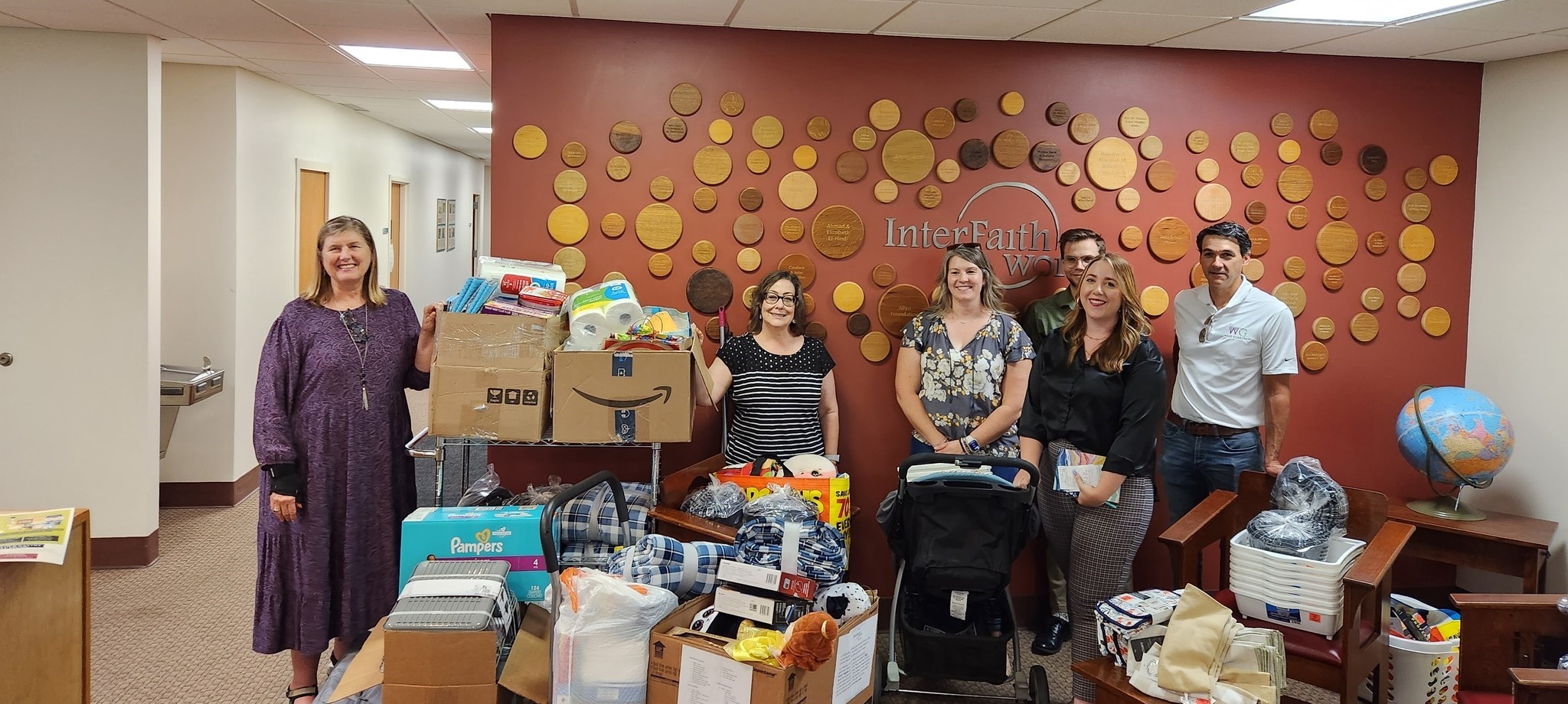
At the beginning of the COVID-19 Pandemic, The American Dairy Association had a milk surplus, and needed community support to distribute it before it spoiled. ADA organizers reached out to Central New York’s InterFaith Works for help.

“So, we began to deliver milk to faith communities — synagogues, mosques, churches, black and brown churches, and because many of our agency programs were paused, we had time deliver all this milk,” said Bishop Colette Matthews-Carter, Director of IFW’s El-Hindi Center for Dialogue & Action. “ It was a huge blessing to people in our community.”

After seeing the overwhelming community response, InterFaith Works started to distribute food boxes, and a network of food pantries began to organically form. Now nearly three years later, IFW connects and helps support 32 grassroot food pantries and partners as a part of its Food Justice Program. It aims to deliver healthy food to diverse neighborhoods experiencing the highest rates of poverty and food insecurity in Syracuse.

The Food Justice Coordinator convenes monthly meetings, sets a legislative advocacy agenda, and aids pantries in securing additional support. They also oversee two community gardens, one which launched in June 2024. The organization estimates that just last year they were able to distribute more than 30,000 bags of food to families across Syracuse.

Matthews-Carter credits the success of the program to the partner pantries that have built community trust over decades of work. Sometimes asking for help can be difficult, she said, and that lining up for free food can sometimes feel “dehumanizing” if not done with care.

“Our pantries are in entrusted community spaces; they are in places where people do feel safe, and people feel like there is no judgment,” said Matthews-Carter.

This care is central to InterFaith Work’s overall mission to “Affirm Dignity.” This commitment to dignity extends to their work in food justice. Matthews-Carter said it’s important to have food that is culturally and religiously-appropriate.

Nearly 50,000 people in Onondaga County live with food insecurity due both to economic factors and lack of community food access. Almost half of Syracuse children live in poverty, and with inflation and SNAP reductions, the need for food access is growing. The term “food desert” is often used to describe neighborhoods that don’t have access to affordable, healthy food options due to the absence of grocery stores within an easy traveling distance. Some advocates say that we should use the term “food apartheid” instead, because it more accurately points to the structural injustices and disparities in food access faced by low-income communities and communities of color.

Food and hunger are not isolated issues, but part of larger systemic issues that affect everyone in our region.

“You can’t just talk about hunger without talking about housing, you can’t talk about health without talking about food,” said Qiana Williams, program officer at the Community Foundation. “So they’re all interrelated, because those are the things that are a mainstay for any human. Collaborations are critical to the success of this. The fact that InterFaith Works has galvanized these forces across sectors addressing health, hunger, and housing, in some very unique ways; it is very powerful, because it’s sending the message to folks in need that there are people who care about you, and you can go here and you can be supported.”

Williams said this program is ultimately an infrastructure success building initiative. The coordinator helps connect the community and aids smaller food pantries in securing food, applying for accreditation, and convening to share best practices.

Food justice and advocacy continues to gain momentum in Central York with community organizations like the Syracuse-Onondaga Food Systems Alliance (SOFSA) and IFW. Matthews-Carter said that there’s still work to be done. She anticipates continued support around food distribution and community-food production.

“I think the food justice conversation needs to be elevated in our community, Matthews-Carter said. “We’d like community stakeholders, faith communities, elected officials, school districts to break down their silos and just come together as a community to ensure that we have adequate and healthy food for future generations.”

Share

Lending Tree Study Ranked Syracuse Second in Economic Disparity

Community health, like personal health, requires a holistic approach. To thrive as a community, we need strong employment opportunities, access to good homes, and schools that prepare our young people for the future to name a few.

In order to determine the economic health of an area, experts look at metrics like education, home ownership, household income, and the unemployment rate. Without this data, it’s hard to understand where we are as a community and what stories that data tells about it.

In the fall of 2023, a study from LendingTree ranked Syracuse 2nd in economic disparity for Black residents. LendingTree analyzed five years of data from the U.S. Census, which focused on five metrics: education, home ownership, household income, the percentage of Black households making six figures, and the unemployment rate. Syracuse ranked 93rd or below in all five categories. So, how did we get to this point and what are we doing as a community to help address this inequity?

History of Redlining and its Effects on Current Housing 

One indicator of a strong and thriving local economy is the rate of home ownership. There’s a long list of both personal and communal benefits of owning a home. It allows individuals to build wealth, access tax credits, and generate a sense of community. While neighborhoods with higher rates of homeownership tend to have higher property values, which means there’s additional funding for public services like schools and infrastructure. A home provides stability and can be passed down from one generation to the next.

Unfortunately, not everyone in our community has had equal access to purchasing a home. For Black residents, a history of racist housing policies and community disinvestment has led to inequality in homeownership. Some of the most impoverished areas of Syracuse today reflect redlined districts resulting from the National Housing Act of 1934, which led to a large increase in residential racial segregation and urban decay in US cities. While redlining is no longer considered a lawful practice under the Fair Housing Act of 1968, the effects of these deeply rooted inequalities continue to live on.

Right now, only 28.6% of Onondaga County’s Black residents own their homes compared to 72% of White residents, according to the Lending Tree Study . Black homeowners also pay more for mortgage loans, which only works to set families back from achieving financial freedom.

Local nonprofits such as Home HeadQuarters and the Greater Syracuse Land Bank have worked for decades to address the multifaceted housing issue. This includes increasing the local housing stock, remediating lead in homes, and providing accessible loans for Black citizens. For example, Home HeadQuarters (HHQ) has spearheaded efforts to cut racial gaps in mortgage lending during the last three years. HHQ has made more than 200 home-purchase loans, which totaled $22.4 million with more than half of that lending going to Black or mixed-race borrowers.

Combined with the recent announcement of the Syracuse Housing Strategy and its investment in the local housing stock, there’s hope for a stronger housing future in Central New York.

Education: Where We Are, Where We Can Grow 

When looking at the metrics for economic disparity, you can see how interconnected the metrics are. Strong educational systems create pathways to good paying jobs, which creates enough wealth for homeownership, which in turn feeds the public schools system. These metrics are interconnected and need multi-pronged solutions in order to address economic disparities.

Education opens doors to economic opportunity. Census tracts throughout Central New York with lower median incomes had more people in the workforce without a high school diploma compared to tracts with higher median incomes. Historically, there have been significant economic and racial disparities in public school completion rates. In New York State, the graduation rate in 2021 for Black and Hispanic students was 80 percent, compared to 90 percent for White students.

Education has always been deeply connected to the wealth of a region.  Incomes are tied to public school completion and level of income. One positive sign is that, in Syracuse, disparities in graduation rates between some racial groups have decreased in recent years. In 2021, Black students in the Syracuse City School District had a higher graduation rate than white students (80% compared to 76%).

Due to the efforts of Central New Yorkers over the last two decades, the region is poised for rapid economic growth in the next ten years. One way to ensure equity in opportunities is through an investment in education and in workforce development which ensures that Central New Yorkers can fill in-demand and good-paying jobs in the tech and manufacturing sector. Community advocates are working to ensure that the most vulnerable communities benefit from this historic investment.

Workforce Development

Providing job opportunities with livable wages is critical for community and personal well-being. Lack of opportunity and underemployment creates hard decisions for families on where to spend finite resources.  Unemployment rates across the country skyrocketed due to the COVID-19 pandemic, and cities across the US are still recovering.

In 2021, Syracuse had almost 90,000 unemployment beneficiaries, which was over seven times as many as the city saw before the pandemic. Historically these dips affect marginalized communities at a higher rate. For Black Americans, the unemployment rate is often 2-3 percent higher than their White counterparts.

Through initiatives like Syracuse Surge, the region is investing in new employment opportunities for its residents.  Through partnerships, Syracuse Surge invests in reskilling and upskilling Central New York residents for careers in coding, cybersecurity, and high-tech manufacturing. Since the program launched in 2019, it has reskilled and upskilled more than 1,000 city residents for careers in tech. This workforce development is crucial as Micron’s historic $100 billion investment promises to create up to 90,000 jobs in the next 20 years.

As the region attracts historic investment, it’s vital that these opportunities reach Central New Yorkers who currently live here.  In order to improve our community’s economic health and address critical disparities, we have to continue to invest in holistic changes for a better tomorrow.

Share